How to Hang a Hammock on a Deck
A deck looks like it is full of anchor points and is mostly not. Three places can take the load, and the railing is not one of them.
By Mike M. · Last updated
Knot & Nap is reader-supported. We earn from qualifying purchases as an Amazon Associate, at no extra cost to you. Commissions never decide what gets recommended — here is how we pick.
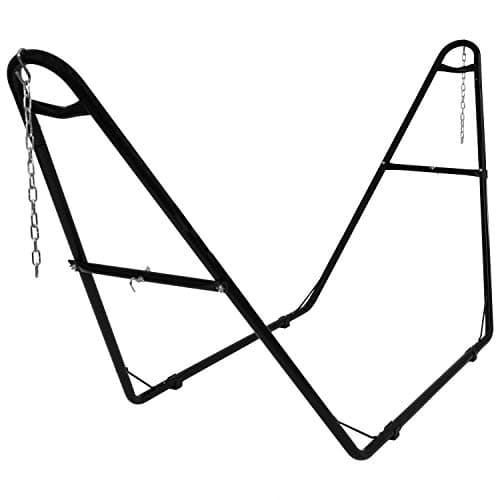
Hang from a structural post, a pergola beam or a ledger-attached header — never from railing balusters or deck boards. If the deck has none of those at the right spacing, put a freestanding stand on it instead: the Sunnydaze Universal publishes 550 lb on powder-coated steel, and the ENO SoloPod has rubber feet that will not mark decking.
Part of our guides hub. A deck sits awkwardly between the two cases this site already covers: it is not trees, and it is not an interior ceiling with joists you can find with a stud finder. What it is, structurally, is a platform with a small number of real load paths and a lot of trim that looks load-bearing and is not. Getting this right is mostly about telling those apart.
What on a deck can take the load
| Deck element | Use as an anchor? | Why |
|---|---|---|
| Structural post (4x4 or 6x6) bolted to the frame | Yes, if you can bolt through it | It is a load path to the footing |
| Pergola or roof beam over the deck | Yes, into the beam itself | Sized for vertical load; check the span and the connection |
| Header or ledger board at the house wall | Sometimes, with a through-bolt into structure | It is structural, but the load direction is not what it was sized for |
| Railing post | No | Designed against a sideways push, not a multiplied pull |
| Railing balusters or top rail | No | Trim, not structure |
| Deck boards | No | They span joists; they carry nothing horizontally |
| A freestanding stand on the deck | Yes — the simplest answer | It brings its own rated geometry and needs no hardware |
Quick picks
Tap any row to jump to the full write-up. Prices come straight from Amazon and are refreshed daily; where a figure is missing the link takes you to the live one.
| # | Product | Best for | Headline spec | Price |
|---|---|---|---|---|
| 1 | Sunnydaze Universal Hammock StandUniversal fit, powder-coated steel and a 550 lb rating — the stand most people should buy when the hammock came without one. | Best overall stand | Universal compatibility | |
| 2 | 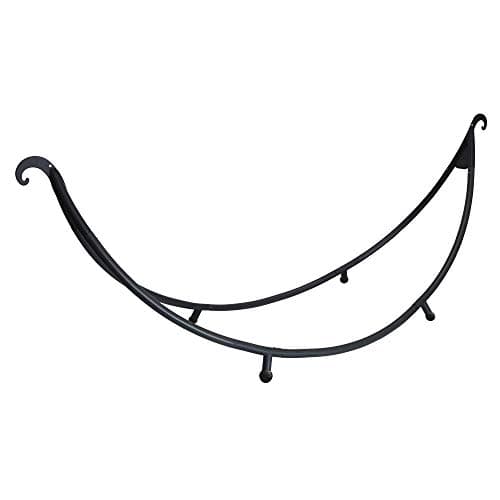 ENO SoloPod Hammock StandRubber feet, 400 lb, and a footprint that sets up in spaces where a full frame does not fit. | Tight spaces on rough ground | Rubber feet | |
| 3 | 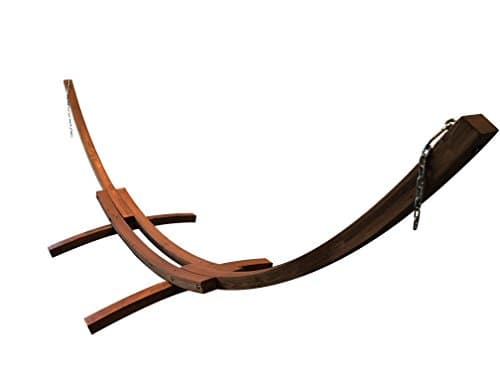 Petra Leisure Wooden Hammock StandA wooden stationary frame — the option when the stand has to look like furniture rather than scaffolding. | Wooden, stationary | 450 lb capacity | |
| 4 |  ENO Atlas Hammock Suspension SystemThe straps everyone else gets compared against — proven, stocked everywhere, a step behind the Python on specs. | The industry standard | 400 lb combined capacity |
#ad — the buy links above are affiliate links. See our affiliate disclosure.
The hardware route, step by step
- 1Confirm the post goes somewhereFollow it down. A post bolted to the rim joist and standing on a footing is a load path. A post that stops at the decking and is toe-nailed into a board is decoration. If you cannot see where it lands, do not hang from it.
- 2Measure the span, then subtractA gathered-end hammock wants a span a little longer than the hammock; a 13 ft spreader-bar hammock plus chains wants about 15 ft. Measure post to post at the height you intend to anchor, not at deck level.
- 3Work out the anchor height from the spanTarget a loaded seat 16 to 19 in above the deck and a suspension angle of roughly 30 degrees. The hang calculator we cite converts span to anchor height; our hanging distance and angle guide carries the same table.
- 4Through-bolt rather than screwA hammock anchor in a post should be a bolt that passes through the timber with a washer and nut on the far side, not a lag screw biting into end grain. Drill on the centerline of the post, horizontally, and keep the hardware clear of any existing connector plates.
- 5Add straps for the adjustmentEven with fixed anchors, webbing straps let you tune the sag. The ENO Atlas publishes 400 lb combined, 9 ft of length and 15 attachment points, which is enough adjustment to find the right hang without moving hardware.
- 6Load it before you trust itSit, then lie, then let someone else get in. Watch the post for movement at the deck line. Any flex at the base means the post is not the anchor you thought it was — stop and use a stand.
The stand route, which is usually better
On a deck, a stand is not the fallback — for most people it is the right answer. There is nothing to drill, no structural judgement to make, and nothing that voids a builder's warranty. The three picks here cover the three situations: the Sunnydaze Universal for a flat deck with room, at 550 lb on powder-coated steel; the ENO SoloPod for a small or sloping deck, at 400 lb with rubber feet that will not mark composite boards; and the Petra Leisure wooden arc for a deck where a steel frame would look wrong, at 450 lb on a 14 ft frame.
Two deck-specific cautions on stands. Feet matter: bare steel marks composite decking and can walk across a hard surface as the hammock swings, which is what the SoloPod's rubber feet solve. And length matters more than on grass, because a 14 ft wooden arc needs 14 ft of deck plus walking room. See best hammock stands and wooden hammock stands.
Under a deck, not on it
If the deck is raised, the space beneath it is often the better hang: the posts down there are full-height and well braced, there is shade, and a hammock under a deck is out of the rain. The same rule applies — bolt through a post that reaches a footing, never into the underside of the decking or into a joist hanger.
Common questions
Can you hang a hammock from deck railings?
No. Railing posts are engineered against a horizontal push, not against the multiplied inward and downward pull a hammock applies, and balusters and top rails are trim rather than structure. Use a structural post, a beam, or a stand.
How do you hang a hammock on a deck without drilling?
A freestanding stand. The Sunnydaze Universal publishes 550 lb and the ENO SoloPod 400 lb with rubber feet for a hard surface, and neither needs any hardware attached to the deck.
What size posts do you need for a deck hammock?
Use the deck's own structural posts rather than adding new ones, and only if you can trace them to a footing. A post that stops at the decking is not a load path, however thick it looks.
Should you bolt or screw a hammock anchor into a post?
Through-bolt, with a washer and nut on the far side, drilled on the post's centerline. A lag screw into end grain is not an appropriate connection for a load that is multiplied by a shallow hang angle.
How far apart should the anchors be on a deck?
A little more than the hammock's length for a gathered-end hammock, and about 15 ft for a 13 ft spreader-bar hammock once its chains are on. Aim for a loaded seat 16 to 19 in above the deck.
Sources
Every specification on this page traces to one of these — manufacturer data, owner's manuals, published standards and named independent publications, all linked so you can check them yourself.
Read next
Spotted something we got wrong? Tell us — corrections are part of our editorial policy.