Underquilt vs Sleeping Bag
A sleeping bag does not fail in a hammock. Half of it does — the half you are lying on — and that is the half that was keeping you warm.
By Mike M. · Last updated
Knot & Nap is reader-supported. We earn from qualifying purchases as an Amazon Associate, at no extra cost to you. Commissions never decide what gets recommended — here is how we pick.
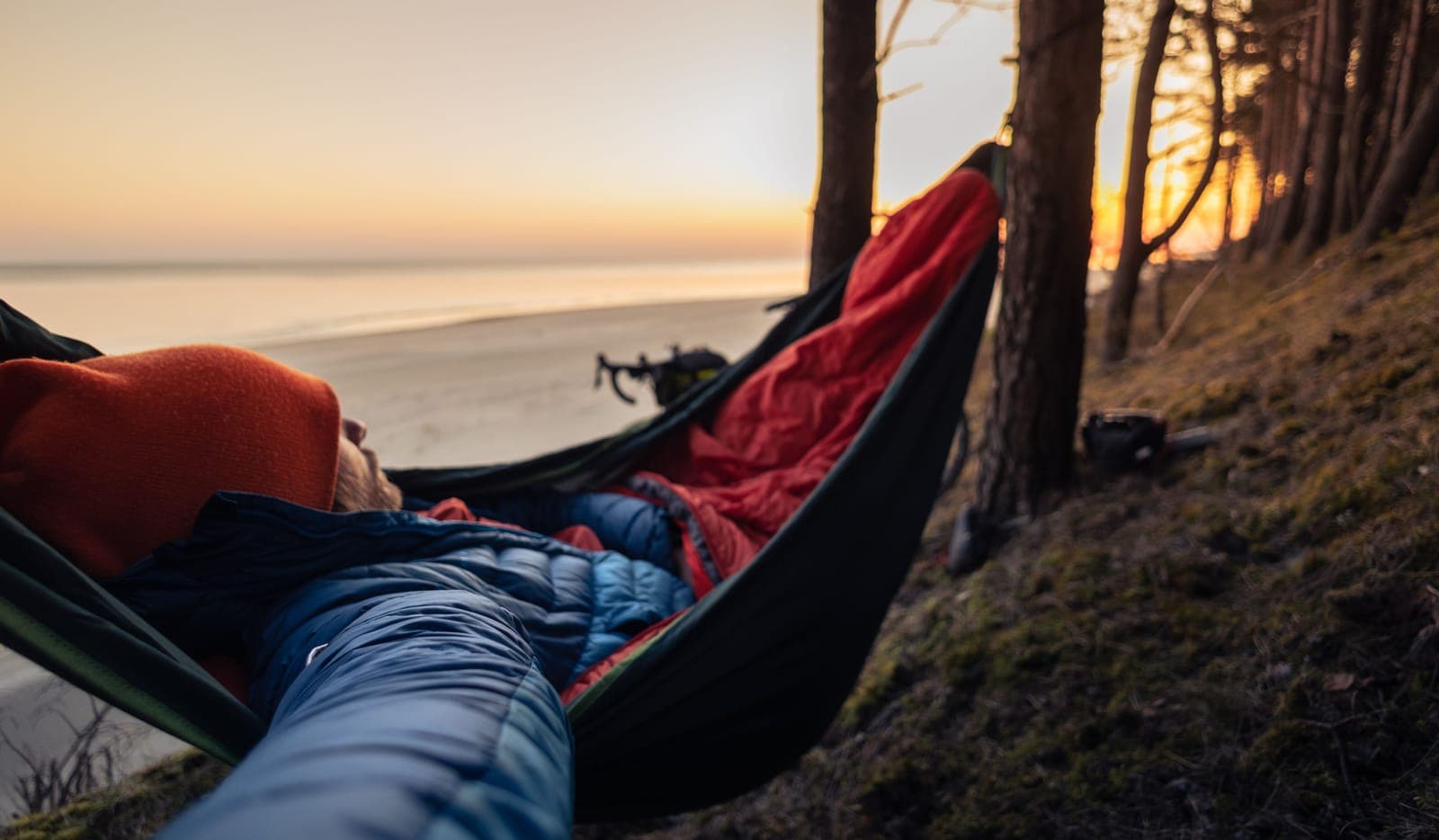
Use an underquilt. It hangs outside the hammock, so nothing compresses it, and Hammock Gear puts 65 to 70 percent of your heat loss through the hammock fabric beneath you. A sleeping bag still works over the top — its underside is simply dead weight once you are in a hammock.
Part of our comparisons hub. This is the comparison that catches almost everyone out on their first cold hammock night, because the bag that was fine on the ground last month is suddenly not fine four feet in the air.
Why a sleeping bag stops working underneath you
Insulation traps air. Down and synthetic fill both work by holding still air in loft, and loft is exactly what your body weight destroys. On the ground this barely matters, because a sleeping pad underneath the bag does the insulating instead. In a hammock there is no pad by default — just a single layer of nylon with moving air on the other side of it, and a crushed layer of fill between you and that nylon doing nothing at all.
Hammock Gear states that about 65 to 70 percent of your body heat escapes from your backside through the thin layers of the hammock's fabric. That is the number worth remembering: the part of the bag you have just disabled is the part that was doing most of the work.
Factor by factor
| Factor | Underquilt | Sleeping bag in a hammock |
|---|---|---|
| Where it sits | Outside, hanging under the hammock | Inside, with you on top of it |
| Compression | None — nothing presses on it | Fully compressed underneath you |
| Heat loss it addresses | The 65 to 70 percent that goes out through your back | The remaining 30 to 35 percent over the top |
| Rating you actually get | As published | Far less than the label, underneath |
| Weight | 27 oz (ENO Ember); 1.7 lb (Aerie at 30F) | Whatever the bag weighs, half of it wasted |
| Getting in and out | Nothing inside the hammock to fight | Zip, hood and fabric bunching under you |
| Works on the ground | No | Yes |
| Cost | A second purchase | You probably already own one |
Quick picks
Tap any row to jump to the full write-up. Prices are not shown anywhere on this site — we link straight to Amazon so you see the live figure.
| # | Product | Best for | Headline spec | Price |
|---|---|---|---|---|
| 1 |  Hammock Gear Incubator Underquilt850-fill down in five temperature ratings and three lengths, which is the closest this category gets to a quilt cut for your body and your season. | Best backpacking underquilt | Temperature ratings 40F, 30F, 20F, 10F and 0F | |
| 2 | ENO Ember UnderQuiltENO's own synthetic quilt, and the only one whose fit with a DoubleNest is a published compatibility statement rather than an assumption. | Best underquilt for a DoubleNest | 40 to 60 degrees F (4 to 15 C) | |
| 3 | Outdoor Vitals Aerie Down Underquilt800+ fill down in four temperature ratings that also works as a sleeping bag — the quilt for people who do not only hang. | Down warmth, and it converts | 0, 15, 30 and 45 degrees F options | |
| 4 | Hammock Gear Burrow Top QuiltThe Incubator's other half: the same 850-fill down and the same five ratings, cut to go over you instead of under. | Best top quilt overall | Temperature ratings 40F, 30F, 20F, 10F and 0F |
#ad — the buy links above are affiliate links. See our affiliate disclosure.
When a sleeping bag is still the right call
- Mild nights. Above roughly 65F you may not need under-insulation at all, and a bag over the top is plenty.
- You already own one and you are trying hammock camping once. Add a foam pad inside the hammock and the bag becomes workable.
- Mixed trips. If half your nights are on the ground, one bag covers both and an underquilt covers neither.
- As a top layer. A bag used unzipped as a blanket over an underquilt is a perfectly good system, and it is what a lot of people do before they buy a top quilt.
The workaround, and its limits
Put a sleeping pad inside the hammock, under the bag. The pad takes the compression, the bag stays lofted above it, and the system works. This is the standard budget answer and there is nothing wrong with it. What it is not is comfortable — pads crinkle, slide, and squirt out from under you unless they are hammock-shaped, which is why the Klymit Insulated Hammock V is 47 inches wide with wings. The full argument is in underquilt vs sleeping pad.
What it costs to switch
Less than people expect at the budget end and more than they expect at the top. A synthetic quilt such as the OneTigris Hideout publishes 41F to 68F at 1.7 lb; an 850-fill Hammock Gear Incubator in a 20F rating is a different order of purchase. Our budget underquilt page covers the cheap end and backpacking underquilts covers the weight-critical end.
The verdict
Buy the underquilt. It is not a refinement or an upgrade — it is the piece of equipment that makes cold-weather hammock camping work at all, because it is the only arrangement where the insulation underneath you stays lofted. Keep the sleeping bag and use it over the top until you decide a top quilt is worth the money. If you are not ready to spend, put a pad in the hammock tonight and buy the quilt before the temperature drops again.
Common questions
Can you use a sleeping bag instead of an underquilt?
Over the top, yes. Underneath you, not effectively — your body weight crushes the fill flat so it traps no air. Hammock Gear puts 65 to 70 percent of heat loss through the hammock fabric beneath you, which is precisely the part a compressed bag cannot address.
Do you need both an underquilt and a sleeping bag?
You need insulation below and above. An underquilt handles below; a bag or a top quilt handles above. Running a bag over an underquilt is a common and perfectly sound setup, and it is what most people do before they buy a dedicated top quilt.
Why am I cold in a hammock in a warm sleeping bag?
Because the bag is compressed underneath you and air is moving freely under the hammock. It is not the air temperature and it is not the bag's rating. A warmer bag does not fix it; insulation that is not being crushed does.
At what temperature do you need an underquilt?
Sooner than on the ground. ENO's Ember quilt starts at 60F at the top of its range, which tells you the category treats the mid-60s Fahrenheit as the point where under-insulation starts to matter in a hammock.
Is a sleeping bag or a quilt better for hammock camping?
A quilt, once you are committed. A bag carries a hood, a zip and an underside that do nothing useful in a hammock. See underquilt vs top quilt for how the two quilt types divide the job.
Sources
Every specification on this page traces to one of these. Where a recommendation rests on another publication's hands-on testing, we name it — we do not run a test lab.
Read next
Spotted something we got wrong? Tell us — corrections are part of our editorial policy.