Underquilt vs Sleeping Pad
An underquilt hangs outside the hammock and cannot be compressed. A pad goes inside, costs less, and works on the ground as well.
By Mike M. · Last updated
Knot & Nap is reader-supported. We earn from qualifying purchases as an Amazon Associate, at no extra cost to you. Commissions never decide what gets recommended — here is how we pick.

Use an underquilt if you hammock regularly: it hangs outside, so your weight never compresses it, and it is the more comfortable system. Use a pad if you also camp on the ground, want to spend less, or need a genuinely cold rating — the Klymit Hammock V publishes R-4.4.
Part of our comparisons hub. Both solve the same problem: in a hammock, air moves freely underneath you and your sleeping bag is squashed flat beneath your body, so the insulation you are lying on stops insulating. That is the cold-back problem, and a warmer bag does not fix it.
Factor by factor
| Factor | Underquilt | Sleeping pad |
|---|---|---|
| Where it sits | Outside, hanging under the hammock | Inside, under you |
| Compression | None — nothing presses on it | Compressed by your body weight |
| Example rating | 40–60 F (ENO Ember); 0 F available (Aerie) | R-value 4.4 (Klymit Hammock V) |
| Weight | 27 oz (Ember); 1.7 lb (Aerie 30 F) | 35 oz (Klymit Hammock V) |
| Comfort | Nothing between you and the hammock | Crinkles, slides, can squirt out |
| Cost | Higher | Lower |
| Works on the ground | No | Yes |
| Setup | Shock cord over the hammock ends | Inflate and position |
| Draughts | Sealed against the hammock when set right | Gaps at shoulders and hips |
Quick picks
Tap any row to jump to the full write-up. Prices are not shown anywhere on this site — we link straight to Amazon so you see the live figure.
| # | Product | Best for | Headline spec | Price |
|---|---|---|---|---|
| 1 | ENO Ember UnderQuiltENO's own synthetic quilt, and the only one whose fit with a DoubleNest is a published compatibility statement rather than an assumption. | Best underquilt for a DoubleNest | 40 to 60 degrees F (4 to 15 C) | |
| 2 | 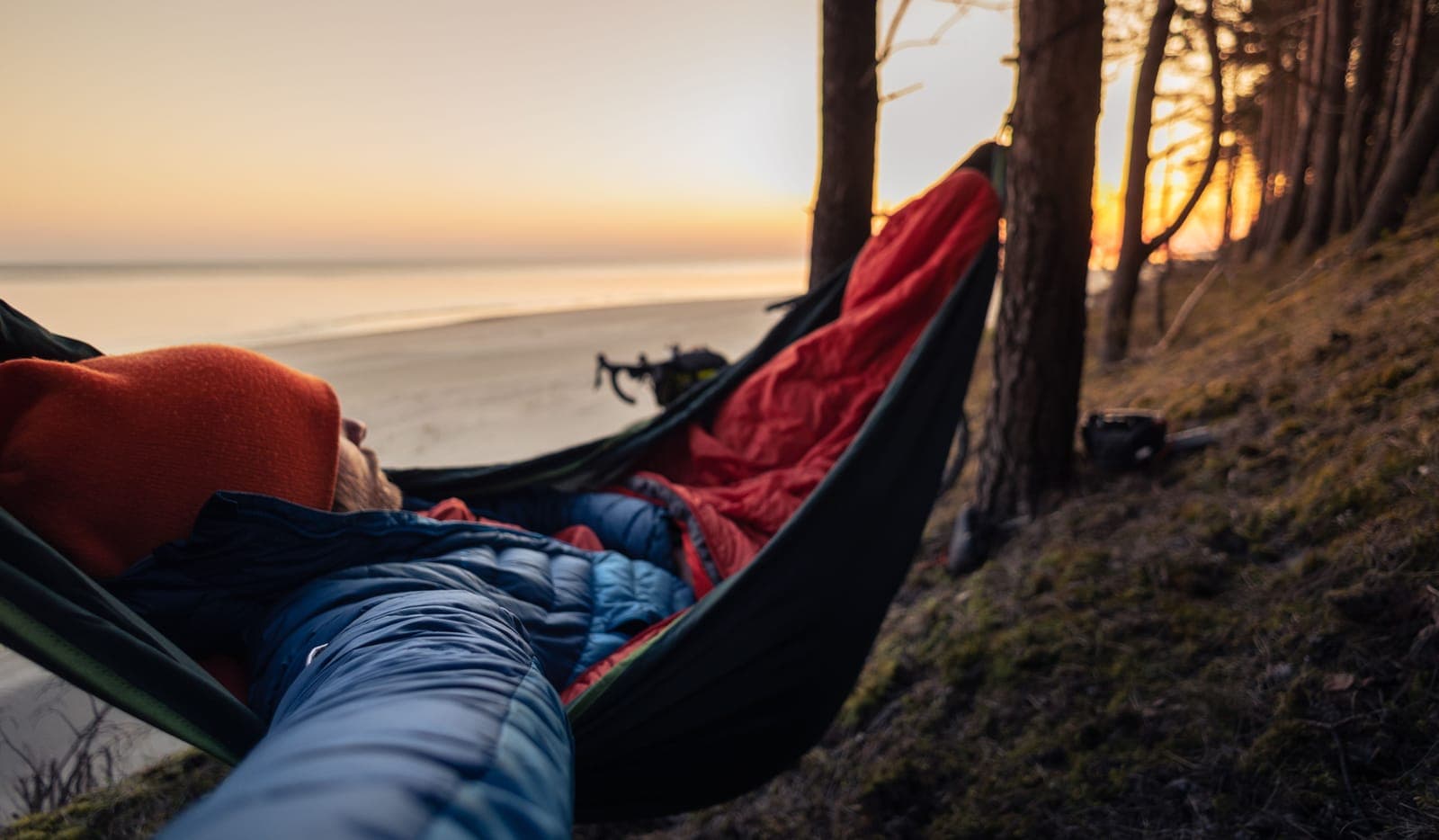 Klymit Insulated Hammock V Sleeping PadA 47-inch-wide pad with wings and non-slip zones — the one sleeping pad designed to stay under you in a hammock instead of squirting out. | The pad built for hammocks | R-value 4.4 insulated; 1.6 uninsulated | |
| 3 | Outdoor Vitals Aerie Down Underquilt800+ fill down in four temperature ratings that also works as a sleeping bag — the quilt for people who do not only hang. | Down warmth, and it converts | 0, 15, 30 and 45 degrees F options | |
| 4 | Onewind Hammock UnderquiltOnewind's standard underquilt range, rated 35–50°F and 45–70°F depending on the model you pick. | Three-season warmth | Temperature ratings from 35°F to 50°F (2°C to 10°C) and 45°F to 70°F (7°C to 21°C) depending on model |
#ad — the buy links above are affiliate links. See our affiliate disclosure.
Why the underquilt is the better system
Because insulation only works when it is lofted, and an underquilt is the only arrangement where nothing presses on it. Hung correctly it seals against the underside of the hammock and moves with you. There is nothing inside the hammock to slide off, roll on or wake up beside, and once it is set you stop thinking about it.
The catch is that it only does this one job. An underquilt is useless on the ground, so a season of mixed trips means carrying it and a pad. See the best hammock underquilts for the range, and underquilts for the ENO DoubleNest if that is the hammock you own.
Why the pad still makes sense
- It has an R-value. R-4.4 on the Klymit Hammock V is a real, comparable winter number. Underquilt temperature ranges are not standardised the same way.
- It works on the ground. One pad covers hammock trips and tent trips.
- It costs less. Usually significantly.
- Hammock-specific pads exist. The Klymit is 47 inches wide with wings and non-slip zones precisely because a rectangular pad squirts out from under you.
- Nothing to hang. No shock cord, no fit question, no compatibility statement to check.
What a pad is like to sleep on in a hammock
Honestly: worse than an underquilt and better than nothing. A pad crinkles against nylon, it slides when you turn, and unless it is wide enough your shoulders and hips end up off the edges — which is exactly where you get cold. The wings and non-slip zones on a hammock-specific pad are there to fight all three of those, and they help rather than solve.
Cold weather changes the answer
For deep cold, the strongest system is both: a pad inside for a floor of R-value, and a quilt outside to stop the draught. That is heavier than either alone and warmer than both. If you are carrying one item into genuine cold, a rated down underquilt such as the Outdoor Vitals Aerie at 0 F is the lighter route — with the caveat that down under a hammock sits exactly where condensation forms. More on that in hammock camping in rain and cold.
The verdict
If most of your nights are in a hammock, buy the underquilt — it is the more comfortable and more effective system, and the one you will keep. If you split your nights between a hammock and the ground, or you are trying hammock camping for the first time and do not want to spend twice, buy a hammock-specific pad. And if you are heading somewhere genuinely cold, carry both.
Common questions
Is an underquilt better than a sleeping pad for a hammock?
For warmth and comfort, yes — it hangs outside the hammock so your weight never compresses it, and there is nothing inside to slide around. A pad is cheaper, has a comparable R-value and works on the ground as well.
Can you use a normal sleeping pad in a hammock?
You can, and a standard rectangular pad tends to squirt out from under you and leave your shoulders and hips off the edges. Hammock-specific pads like the Klymit Insulated Hammock V are 47 inches wide with wings and non-slip zones for that reason.
What R-value do I need in a hammock?
The same as on the ground for a given temperature, and then some, because air moves under a hammock on all sides. The Klymit Insulated Hammock V publishes R-4.4 insulated and 1.6 uninsulated, which is a useful reference point when comparing pads.
Do you need both an underquilt and a pad?
Not usually. In genuine cold the combination is the warmest system available — a pad for a floor of R-value and a quilt outside to cut draughts — but for three-season use one or the other is enough.
At what temperature do you need under-insulation in a hammock?
Sooner than people expect. Air moving beneath you makes a hammock feel colder than the same night on the ground, and the ENO Ember starts at 60 F at the top of its range — a summer quilt, not a winter one. Treat mid-60s Fahrenheit as the point to have something.
Sources
Every specification on this page traces to one of these. Where a recommendation rests on another publication's hands-on testing, we name it — we do not run a test lab.
Read next
Spotted something we got wrong? Tell us — corrections are part of our editorial policy.