How to Attach an Underquilt to a Hammock
An underquilt only works if it touches you. Most cold nights with a good quilt come down to two inches of air gap that nobody noticed in the dark.
By Mike M. · Last updated
Knot & Nap is reader-supported. We earn from qualifying purchases as an Amazon Associate, at no extra cost to you. Commissions never decide what gets recommended — here is how we pick.
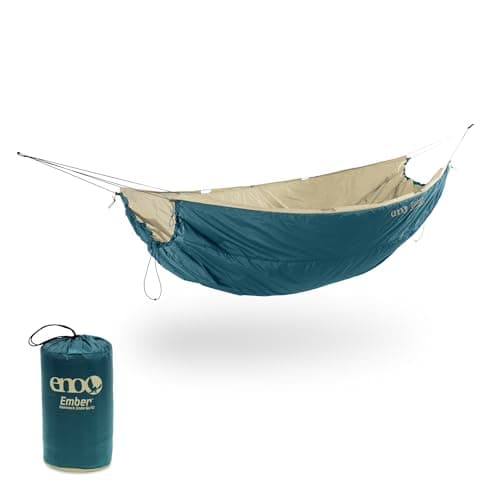
Hang the hammock first and set its sag, then clip the quilt to the hammock suspension at each end — not to the hammock body — and tension the side shock cords until the quilt sits lightly against the underside with no air gap. Get in, then reach out and retension, because your weight changes the shape.
Part of our hammock gear hub. Underquilts are the one piece of hammock kit that fails on fitting rather than on specification. A quilt published at 40 to 60F keeps you warm at 40 to 60F only if it is in contact with the hammock along its whole length. Hang it a couple of inches low and you have built an air channel under your back, which is the exact thing the quilt was bought to prevent.
What to look for in the suspension you are given
- End suspension plus side shock cord. The end lines carry the quilt. The side cords pull the edges up against the hammock. You need both, and they do different jobs.
- Hardware actually in the box. The OneTigris Hideout ships with bungee cord loops and two carabiners. Several quilts ship with none, and a quilt with no suspension is not a usable quilt.
- Published length against your hammock. The Hideout publishes 9.2 ft unfolded, which covers an 11 ft hammock end to end. A quilt that is too short cannot be tensioned into covering your shoulders.
- A published fit, where one exists. ENO states the Ember fits every ENO hammock except the DayLoft and SuperNest. Hennessy publishes a per-model compatibility list for its SuperShelter systems. Everything else is an inference from dimensions.
- Which end is which. Most quilts are wider at the shoulder end. Fitting one backwards is the single most common cause of cold shoulders and warm feet.
Quick picks
Tap any row to jump to the full write-up. Prices come straight from Amazon and are refreshed daily; where a figure is missing the link takes you to the live one.
| # | Product | Best for | Headline spec | Price |
|---|---|---|---|---|
| 1 | ENO Ember UnderQuiltENO's own synthetic quilt, and the only one whose fit with a DoubleNest is a published compatibility statement rather than an assumption. | Best underquilt for a DoubleNest | 40 to 60 degrees F (4 to 15 C) | |
| 2 | 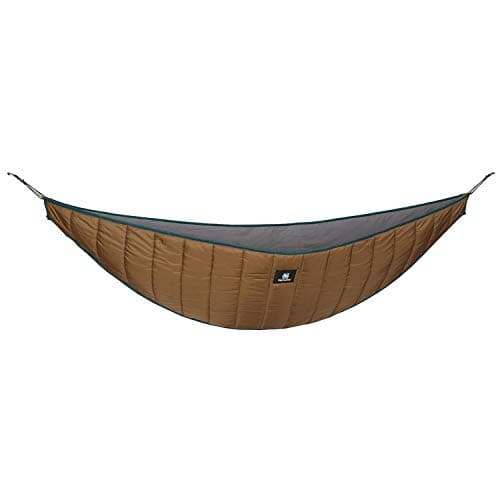 OneTigris Hideout Hammock UnderquiltThe budget benchmark: a full-length quilt that publishes its temperature band, its fill weight and its packed size, which most cheap quilts never do. | Best cheap underquilt | Rated 41F to 68F (5C to 20C) | |
| 3 | 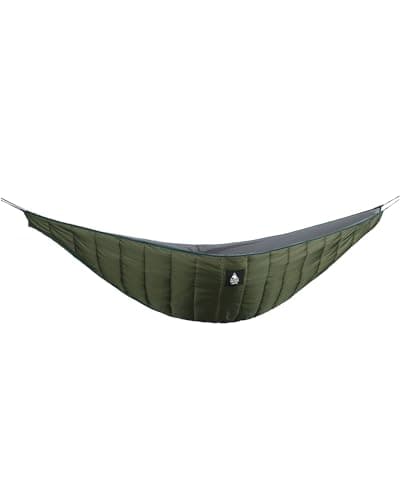 OneTigris Night Protector Ultralight Hammock UnderquiltUnder 25 oz for a full-length synthetic quilt, in a three-season and a winter version, for when down is out of budget but weight still matters. | Lightest synthetic here | 24.7 oz / 700 g | |
| 4 | No image Hennessy SuperShelter 4-Season Insulation System #1Hennessy's own under-insulation, sized to the Expedition and Ultralite Backpacker bodies, and the only insulation with a published fit for them. | Expedition and Ultralite Backpacker | Hennessy lists compatibility with the Expedition Classic, Expedition ZIP, Hyperlite ZIP, Ultralite Backpacker Classic and Ultralite Backpacker ZIP |
#ad — the buy links above are affiliate links. See our affiliate disclosure.
1. Best underquilt for a DoubleNest
ENO Ember UnderQuilt
ENO's own synthetic quilt, and the only one whose fit with a DoubleNest is a published compatibility statement rather than an assumption.
Specifications
- 40 to 60 degrees F (4 to 15 C)
- 100% recycled polyester insulation (160 g) in dual-layer offset quilting
- 27 oz / 754 g
- 6 ft 10 in x 4 ft laid out; packs to 12 x 7 x 7 in
- ENO states compatibility with all ENO hammocks except the DayLoft and SuperNest
Source: eaglesnestoutfittersinc.com Ember UnderQuilt product page, 2026. We publish specs we can attribute and leave the rest blank rather than assuming a typical value.
What it does well
- Published compatibility with the DoubleNest, not inferred from dimensions
- Synthetic keeps working damp, which matters under a hammock
- Recycled insulation at a mainstream price
Where it falls short
- 40 to 60 F is a summer and shoulder-season range, not a cold-weather one
- 27 oz and around 9 liters packed is bulky against a down quilt
Product photograph supplied by Amazon.
#ad we may earn a commission · price as of October 17, 2026
2. Best cheap underquilt
OneTigris Hideout Hammock Underquilt
The budget benchmark: a full-length quilt that publishes its temperature band, its fill weight and its packed size, which most cheap quilts never do.
Specifications
- Rated 41F to 68F (5C to 20C)
- 1.7 lb / 770 g
- Unfolded 9.2 ft x 4 ft (2.8 m x 1.2 m)
- 700 g polyester fill
- 210T Terylene shell with a 300T polyester pongee lining
- Packs to 13 in x 6.8 in (33 cm x 17 cm)
- Bungee cord loops and two carabiners included
Source: camping.onetigris.com Hideout underquilt product page, 2026. We publish specs we can attribute and leave the rest blank rather than assuming a typical value.
What it does well
- Publishes fill weight, packed size and shell fabric, which is rare at this end of the market
- 9.2 ft of length covers an 11 ft hammock end to end
- Bungee suspension and carabiners in the box, so there is nothing else to source
Where it falls short
- 41F at the bottom of its range is a shoulder-season quilt, not a winter one
- 13 x 6.8 in packed is bulky next to a down quilt
Product photograph supplied by Amazon.
#ad we may earn a commission · price as of October 17, 2026
3. Lightest synthetic here
OneTigris Night Protector Ultralight Hammock Underquilt
Under 25 oz for a full-length synthetic quilt, in a three-season and a winter version, for when down is out of budget but weight still matters.
Specifications
- 24.7 oz / 700 g
- Full length 7.9 ft x 4 ft (240 cm x 120 cm)
- Three-season version rated 40F to 68F (5C to 20C)
- Winter version rated 23F to 41F (-5C to 5C)
- Compression stuff sack included
Source: OneTigris Night Protector Amazon listing, 2026. We publish specs we can attribute and leave the rest blank rather than assuming a typical value.
What it does well
- 24.7 oz is lighter than both ENO synthetic quilts
- Synthetic fill keeps working damp, which is the failure mode down has under a hammock
- Two versions cover summer and winter without a custom order
Where it falls short
- Synthetic packs bulkier than 850-fill down at the same warmth
- Seller-published temperature bands with no standardized test behind them
Product photograph supplied by Amazon.
#ad we may earn a commission · price as of October 17, 2026
4. Expedition and Ultralite Backpacker
Hennessy SuperShelter 4-Season Insulation System #1
Hennessy's own under-insulation, sized to the Expedition and Ultralite Backpacker bodies, and the only insulation with a published fit for them.
Specifications
- Hennessy lists compatibility with the Expedition Classic, Expedition ZIP, Hyperlite ZIP, Ultralite Backpacker Classic and Ultralite Backpacker ZIP
- Comprises a silnylon UnderCover, an open-cell foam UnderPad and a radiant heat-reflecting mylar space blanket
- UnderPad is 1/2 in (1.25 cm) open-cell foam, contoured to the hammock's asymmetric shape
- Packed weight 22.4 oz / 635 g for the Expedition and Backpacker fit
- Packed size 5 in diameter x 15 in
Source: hennessyhammock.com SuperShelter #1 product pages, 2026. We publish specs we can attribute and leave the rest blank rather than assuming a typical value.
What it does well
- Fit is a published compatibility list, not a guess from dimensions
- The UnderCover can be fitted or removed without taking the hammock down
- The trapped airspace between cover and hammock does a job no hanging quilt does
Where it falls short
- Hennessy publishes no temperature rating and no R-value for it
- Classic and ZIP versions are different products, and ordering the wrong one is the classic mistake
- An UnderPad plus an UnderCover is more parts to rig than a single quilt
No licensed photograph of this product is available to us yet.
Fitting a hanging underquilt
- 1Hang and set the hammock firstGet the hang angle to roughly 30 degrees and the ride height where you want it before the quilt goes anywhere near it. Changing the hang afterwards undoes the quilt tension — see hanging distance and angle.
- 2Work out which end is the head endWider end to the shoulders. If the quilt has a differential cut or a tapered foot, this is not optional.
- 3Clip the end lines to the suspension, not the hammockAttach to the strap, carabiner or continuous loop just outside the gathered end. Clipping to the hammock body itself drags the fabric and deforms the bed.
- 4Center it under the hammockSight along the length. An off-center quilt leaves a gap along one side, and you will find that side at three in the morning.
- 5Tension the side shock cords until contact is lightSnug, not tight. Over-tightening compresses the insulation and pulls the hammock out of shape; too loose leaves the air gap you are trying to eliminate.
- 6Get in, then retension from insideYour weight drops the hammock into its loaded shape and the quilt has to follow. Reach out and take up the slack at each end, then at the sides. This step is the difference between a warm night and a cold one.
Where the cold spots come from
- Shoulders. The widest, heaviest part of you and usually the narrowest part of the quilt once it is pulled toward the ends. Retension the head end last and hardest.
- Under the knees. The hammock changes angle sharply here and a flat quilt bridges across instead of following it. A slightly looser setting at the foot end lets it follow the curve.
- One side only. Nearly always an off-center fit rather than a cold quilt.
- The gathered ends. Hanging quilts cannot cover the last few inches where the hammock bunches. Clothing covers that, not the quilt.
An undercover is a different system
Hennessy does not sell a hanging quilt at all. Its SuperShelter systems use a silnylon UnderCover, an open-cell foam UnderPad contoured to the hammock shape and a radiant mylar blanket, and Hennessy publishes compatibility per hammock model — system #1 for the Expedition and Ultralite Backpacker bodies at 22.4 oz packed, system #2 for the Explorer Deluxe and Survivor bodies at 26.4 oz. The pad goes inside, the cover goes outside, and the trapped airspace between the two does a job no hanging quilt does. It also means there is no quilt to retension in the dark, and the UnderCover can be fitted or removed without taking the hammock down.
The trade is parts count and no published temperature rating or R-value. If you own a Hennessy, read their compatibility list before buying anything else — ordering the Classic version for a ZIP hammock is the classic mistake. For everything else, the hanging quilt is the mainstream answer, and best hammock underquilts is where to start.
Common mistakes
- Clipping to the hammock body. Deforms the bed and drags the quilt out of position as you move.
- Pulling it tight. Compressed insulation does not insulate, and a tight quilt fights the hammock for shape.
- Fitting it before setting the hang. Every change to the hang undoes the fit.
- Skipping the from-inside retension. The one step that separates people who think their quilt is cold from people whose quilt works.
- Leaving it on in the rain without a tarp. A quilt hanging under a hammock is the lowest point of the system and catches splash — get the tarp right first, per what size tarp for hammock camping.
Common questions
How do you attach an underquilt to a hammock?
Set the hammock hang first, then clip the quilt end lines to the hammock suspension just outside each gathered end — the strap, carabiner or continuous loop, never the hammock fabric. Center it, tension the side shock cords until it rests lightly against the underside, then get in and retension from inside.
Should an underquilt touch the hammock?
Yes, lightly, along its whole length. Any air gap under your back is exactly the heat loss the quilt exists to stop. Light contact is right; pulling it tight is wrong, because compressed insulation loses its loft and stops working.
Why is my underquilt still cold?
Nearly always a fit problem rather than a rating problem. The usual causes are an air gap at the shoulders, an off-center quilt leaving a gap down one side, a quilt fitted the wrong way around, or skipping the retension step once your weight is in the hammock.
Do you attach an underquilt to the hammock or the straps?
The suspension. Clip to the strap, carabiner or continuous loop just outside the gathered end. Attaching to the hammock body drags the fabric, deforms the bed and lets the quilt shift as you move.
Does an underquilt go inside or outside the hammock?
Outside, hanging underneath. The things that go inside are sleeping pads, and the Hennessy SuperShelter is a hybrid — an open-cell foam UnderPad inside, a silnylon UnderCover outside and a mylar blanket between, with compatibility published per hammock model.
Sources
Every specification on this page traces to one of these — manufacturer data, owner's manuals, published standards and named independent publications, all linked so you can check them yourself.
Read next
Spotted something we got wrong? Tell us — corrections are part of our editorial policy.