Hammock Camping in Rain and Cold
A hammock handles rain better than a tent and cold considerably worse. Both are solvable, and the solutions are different pieces of kit.
By Mike M. · Last updated
Knot & Nap is reader-supported. We earn from qualifying purchases as an Amazon Associate, at no extra cost to you. Commissions never decide what gets recommended — here is how we pick.
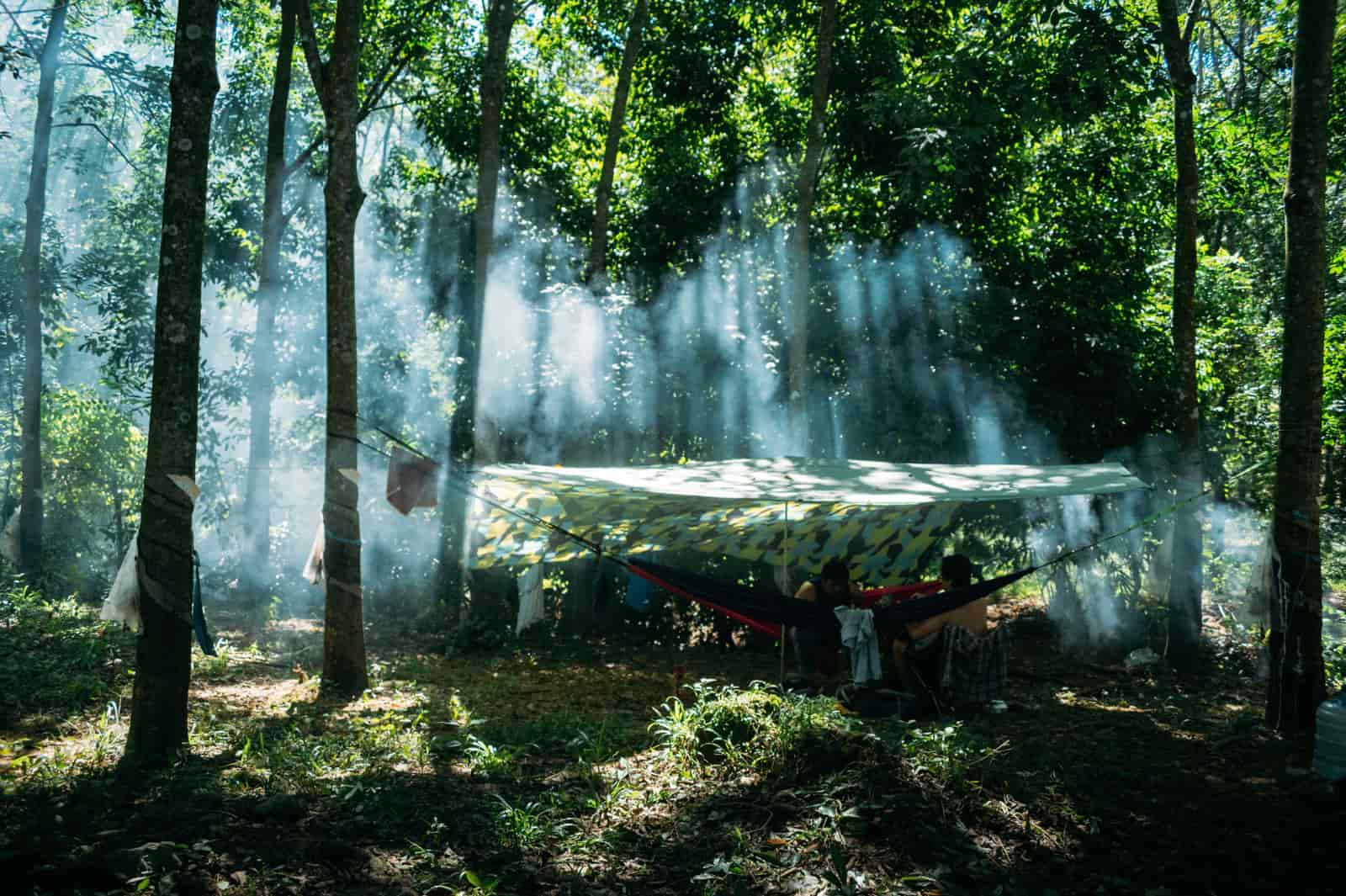
For rain, a tarp with enough width to block wind-driven water — and pitch it on its own ridgeline so you can set up dry underneath. For cold, an underquilt matched to the temperature, because air moves under a hammock and your sleeping bag compresses flat beneath you.
Part of our guides hub. These are the two conditions that turn people off hammock camping, and both are equipment problems with known answers.
Rain: a hammock's natural advantage
In wet weather a hammock beats a tent in one significant respect: you are not on the ground. No puddles under the floor, no seepage, no waking up in a shallow bath because the pitch turned out to be a drainage channel.
What a hammock lacks is walls. That is the tarp's job, and the dimension people under-buy is width, not length.
| Tarp | Coverage | Weight | Doors |
|---|---|---|---|
| Warbonnet Superfly | 132 x 120 in | 12.3 oz | Yes |
| ENO ProFly XL | 13 ft x 9 ft 2 in | 33 oz | No |
| ENO ProFly | 10 ft 6 in x 6 ft 4 in | 22 oz | No |
| ENO ProFly Sil | 10 ft 6 in x 6 ft 4 in | 18 oz | No |
Doors are what four-season actually means. An open-ended tarp handles rain falling straight down; doors handle rain arriving sideways, which is the kind that gets you wet. See best hammock rain flies.
Quick picks
Tap any row to jump to the full write-up. Prices are not shown anywhere on this site — we link straight to Amazon so you see the live figure.
| # | Product | Best for | Headline spec | Price |
|---|---|---|---|---|
| 1 | Warbonnet Superfly TarpA 132 x 120 in four-season tarp with doors, in 20D silpoly at 12.3 oz — winter coverage at a summer weight. | Four-season coverage | 132 x 120 in | |
| 2 | ENO ProFly XL Rain Tarp13 ft by 9 ft 2 in of coverage — the tarp for sideways rain and for keeping gear dry under the hammock. | Maximum coverage | 13 ft x 9 ft 2 in | |
| 3 |  Onewind Solstice Down Hammock UnderquiltA down underquilt rated 32°F to 56°F — the warm end of Onewind's range and the one for shoulder-season nights. | Cold nights | Down insulation | |
| 4 | Onewind Hammock UnderquiltOnewind's standard underquilt range, rated 35–50°F and 45–70°F depending on the model you pick. | Three-season warmth | Temperature ratings from 35°F to 50°F (2°C to 10°C) and 45°F to 70°F (7°C to 21°C) depending on model | |
| 5 | ENO ProFly Rain TarpThe default hammock tarp: 10 ft 6 in of 70D ripstop with a 1000 mm coating, sized for a standard camping hammock. | Best all-round rain tarp | 10 ft 6 in x 6 ft 4 in |
#ad — the buy links above are affiliate links. See our affiliate disclosure.
Pitching order in the rain
- 1Hang the tarp ridgeline firstA separate line between the same two trees. Everything else happens underneath it.
- 2Get the tarp up and stakedYou now have a dry workspace. This is the entire reason for a separate tarp ridgeline.
- 3Hang the hammock underneathStraps, hammock, hang angle, height — all in the dry.
- 4Fit the underquilt before you get inDoing this from inside a hammock in the rain is miserable and it is where gaps get left.
- 5Add drip linesA short length of cord tied round each suspension line outside the tarp gives water somewhere to fall off before it runs down into the hammock.
Cold: the problem nobody warns you about
In a hammock, your sleeping bag's insulation is crushed flat beneath you and traps no air, while air moves freely under the fabric. The result is being cold at temperatures where a tent and a pad would have been fine. This surprises almost every first-time hammock camper.
The fix is insulation on the outside of the hammock. Onewind publishes underquilt ratings from 45 to 70°F on its summer models and 32 to 56°F on the down Solstice, so match the quilt to the season rather than assuming one covers the year.
1. Four-season coverage
Warbonnet Superfly Tarp
A 132 x 120 in four-season tarp with doors, in 20D silpoly at 12.3 oz — winter coverage at a summer weight.
Specifications
- 132 x 120 in
- 11 ft long, 10 ft wide at center
- 12.3 oz
- 20D ripstop silpoly with fully taped seams
- Four-season tarp with doors
Source: Warbonnet Outdoors product page and Trailspace, 2026. We publish specs we can attribute and leave the rest blank rather than assuming a typical value.
What it does well
- Doors close off the ends, which is what four-season coverage actually means
- 12.3 oz for that coverage is remarkable
Where it falls short
- 20D silpoly needs care around sharp branches
- Cottage-brand availability, not shelf stock
Illustrative photograph of the category, not this exact product.
2. Maximum coverage
ENO ProFly XL Rain Tarp
13 ft by 9 ft 2 in of coverage — the tarp for sideways rain and for keeping gear dry under the hammock.
Specifications
- 13 ft x 9 ft 2 in
- 33 oz
- 70D ripstop nylon with 1000 mm PU coating
- Packed 5 x 9 in
Source: ENO product listing and retail listings, 2026. We publish specs we can attribute and leave the rest blank rather than assuming a typical value.
What it does well
- The extra width is what actually keeps you dry in wind-driven rain
- Covers gear as well as the hammock
Where it falls short
- 33 oz is a car-camping weight
- Needs more clear space to pitch
Illustrative photograph of the category, not this exact product.
3. Cold nights
Onewind Solstice Down Hammock Underquilt
A down underquilt rated 32°F to 56°F — the warm end of Onewind's range and the one for shoulder-season nights.
Specifications
- Down insulation
- Rated 32°F to 56°F (0°C to 15°C)
Source: onewindoutdoors.com product page, 2026. We publish specs we can attribute and leave the rest blank rather than assuming a typical value.
What it does well
- Down packs smaller than synthetic for the same warmth
- A published temperature rating, which not every underquilt has
Where it falls short
- Down loses loft when wet, which matters under a hammock
- Costs more than synthetic
Illustrative photograph of the category, not this exact product.
4. Three-season warmth
Onewind Hammock Underquilt
Onewind's standard underquilt range, rated 35–50°F and 45–70°F depending on the model you pick.
Specifications
- Temperature ratings from 35°F to 50°F (2°C to 10°C) and 45°F to 70°F (7°C to 21°C) depending on model
Source: onewindoutdoors.com, 2026. We publish specs we can attribute and leave the rest blank rather than assuming a typical value.
What it does well
- Two rating bands means you can match the quilt to your actual season
- Underquilts beat sleeping pads for hammock insulation
Where it falls short
- You have to read carefully to buy the right band
- Fill weight is not published per model
Illustrative photograph of the category, not this exact product.
5. Best all-round rain tarp
ENO ProFly Rain Tarp
The default hammock tarp: 10 ft 6 in of 70D ripstop with a 1000 mm coating, sized for a standard camping hammock.
Specifications
- 10 ft 6 in x 6 ft 4 in
- 22 oz
- 70D ripstop nylon with 1000 mm PU coating
- Packed 8 x 4.5 x 4.5 in
Source: ENO product listing via REI and retail listings, 2026. We publish specs we can attribute and leave the rest blank rather than assuming a typical value.
What it does well
- 70D fabric takes abuse that a 20D tarp will not
- Sized to cover a standard camping hammock without fuss
Where it falls short
- 22 oz is heavy next to a silnylon or silpoly tarp
- 6 ft 4 in width offers no storm doors
Illustrative photograph of the category, not this exact product.
Condensation
- A tarp pitched low and tight traps moist air. Raise one side when the rain eases to get some airflow.
- Down loses loft when wet, which matters for an underquilt hanging in damp air all night. Synthetic is the wetter-climate choice.
- Keep your gear off the hammock's low point, where any moisture that does get in will collect.
- Dry everything properly at home. A quilt packed damp is a quilt that smells and loses loft.
When to use the ground instead
Sustained high wind with a tarp is unpleasant and noisy, and genuinely cold conditions ask more of a hammock system than of a tent and a pad. If your trips run into real winter, the honest comparison is in hammock vs tent — there is no shame in owning both.
Common questions
Can you hammock camp in the rain?
Yes, and it is one of a hammock's strengths — you are off the ground entirely. You need a tarp with enough width for wind-driven rain, and it is much easier if you pitch the tarp on its own ridgeline first.
How cold is too cold for hammock camping?
It depends entirely on your insulation. Onewind's summer underquilts are published at 45 to 70°F and the down Solstice at 32 to 56°F. Below your quilt's rating you will be cold, and air moving underneath makes it feel colder than the same temperature in a tent.
Why am I cold in my hammock?
Because your sleeping bag is compressed flat underneath you and does nothing, while air circulates below the fabric. The fix is an underquilt on the outside of the hammock, or a sleeping pad inside it.
Do I need a tarp with doors?
For shoulder seasons and windy conditions, yes. Doors close off the ends and block sideways rain. In settled summer weather an open tarp is lighter, faster to pitch and more pleasant.
Sources
Every specification on this page traces to one of these. Where a recommendation rests on another publication's hands-on testing, we name it — we do not run a test lab.
Read next
Spotted something we got wrong? Tell us — corrections are part of our editorial policy.