Are Hammocks Safe?
A hammock is as safe as its weakest component and its hanging height. Both are things you choose, which is why almost every hammock accident is preventable.
By Mike M. · Last updated
Knot & Nap is reader-supported. We earn from qualifying purchases as an Amazon Associate, at no extra cost to you. Commissions never decide what gets recommended — here is how we pick.
Yes, when two things are true: every link in the chain is rated above your load, and the seat sits 16 to 19 in off the ground so a failure is a short drop onto your backside. The hammock bed is almost never the part that fails. Straps, hardware and anchors are, and straps are frequently the lowest published number in the system.
Part of our guides hub. People search "are hammocks dangerous" and find either reassurance or horror stories, neither of which is useful. The honest version is that the risk is entirely in the setup, and the setup has about five decisions in it. Here they are.
What actually fails
| Link | Typical published rating | Why it fails |
|---|---|---|
| Hardware — S-hooks, carabiners, eyelets | Usually not published at all | The least documented link, and often the oldest part of the setup |
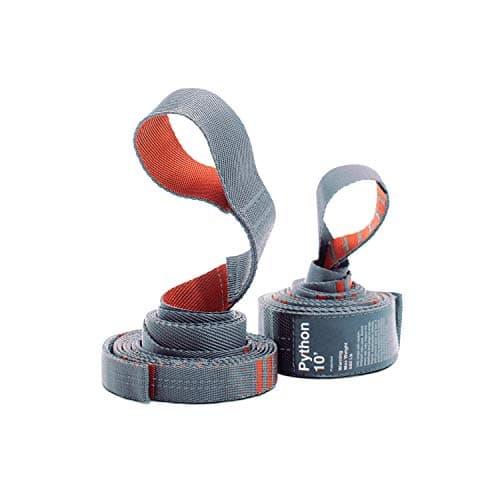
| Straps | 300 lb (ENO Helios) to 500 lb (Kammok Python 10) | Frequently the lowest number in the chain, and nobody checks it |
| The anchor | A stand is rated; a tree is not | Dead limbs, shallow-rooted trees, railings used as anchors |
| The hammock bed | 275 lb to 600 lb across this site | Rarely the failure; cotton weakens if it is left wet |
| The stand | 450 lb to 600 lb on the picks here | Tipping on soft or sloped ground, not breaking |
Quick picks
Tap any row to jump to the full write-up. Prices come straight from Amazon and are refreshed daily; where a figure is missing the link takes you to the live one.
| # | Product | Best for | Headline spec | Price |
|---|---|---|---|---|
| 1 | Kammok Python 10 Hammock StrapsLonger, lighter and higher-rated than the category default — the straps most people should buy. | Best straps overall | 500 lb combined capacity | |
| 2 | 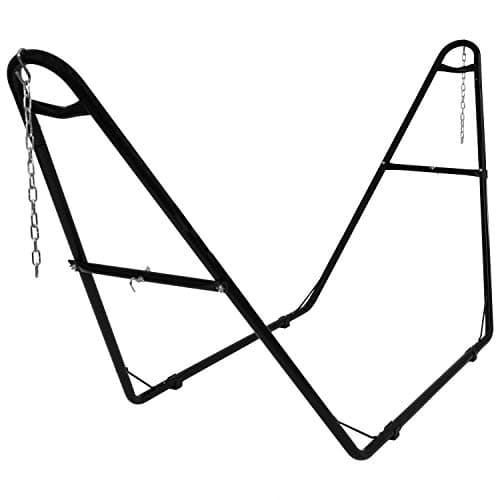 Sunnydaze Universal Hammock StandUniversal fit, powder-coated steel and a 550 lb rating — the stand most people should buy when the hammock came without one. | Best overall stand | Universal compatibility | |
| 3 | 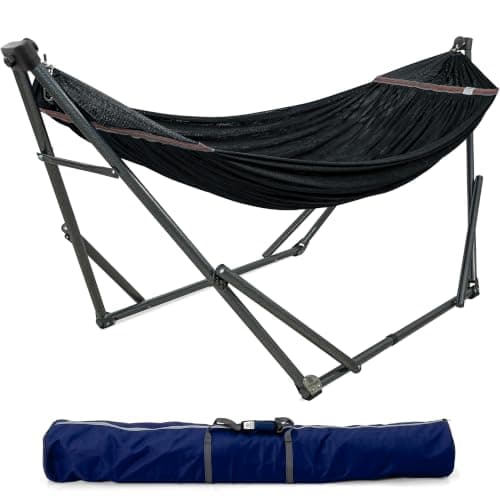 Tranquillo 600 lb 2-Person Adjustable Hammock Stand600 lb, adjustable and collapsible — the rare stand that does not trade capacity for portability. | Heavy-duty and still portable | 600 lb capacity | |
| 4 | 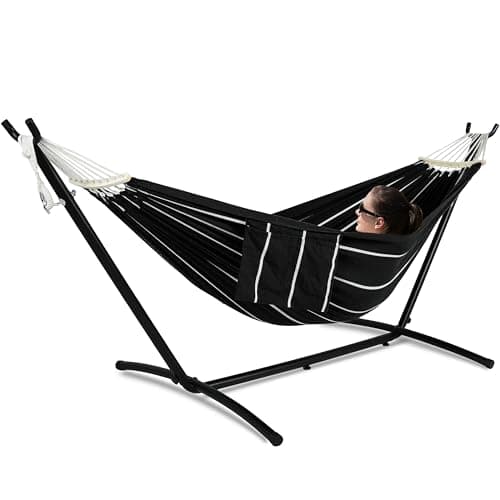 GAFETE Double Hammock with Stand600 lb in a complete set — one of only two sets in this registry that clears two large adults with real margin. | Highest published capacity | 600 lb capacity |
#ad — the buy links above are affiliate links. See our affiliate disclosure.
The weakest-link rule
Your setup's capacity is the lowest single figure in it. A 600 lb hammock on 300 lb straps is a 300 lb setup. This matters because people upgrade the bed and keep the hardware, and the hardware was the limit all along. The Kammok Python 10 is on this page specifically because 500 lb combined is the highest strap figure in the test we cite, which raises the floor of the whole system. The arithmetic version is on hammock weight limits.
Then remember that published figures are static ratings. Dropping into a hammock briefly multiplies the force through the suspension well beyond your body weight, and a tight hang multiplies it further again. Treat a rating as a ceiling to stay comfortably under rather than a target to approach.
Hang low — it is the whole safety story
Height is the one variable that converts a failure into a non-event. The conventional target is a loaded seat sitting 16 to 19 in off the ground at a suspension angle of roughly 30 degrees from horizontal. At that height a strap letting go is undignified rather than dangerous. At chest height it is an injury. The hang calculator we cite will give you anchor heights for any span; the reasoning is on hammock hanging distance and angle.
Hanging low also reduces the force. A shallower, tighter hang multiplies tension at the anchors; a deeper sag at 30 degrees keeps it closer to your actual weight. The safe configuration and the comfortable configuration are the same configuration, which is a rare piece of good news.
Anchors: trees, stands and the things that are not anchors
- Trees. Live, at least a foot thick, with no dead limbs overhead. Wide webbing, never bare cord. A tree has no published rating, which is the argument for a stand.
- Stands. A rated anchor you can trust and move. The Sunnydaze Universal publishes 550 lb on powder-coated steel; the Tranquillo 600 and the GAFETE set both publish 600 lb. Set them on level ground — a stand on a slope tips long before it breaks.
- Not anchors: balcony railings, fence posts, deck balusters, drywall, beadboard porch ceilings, and anything you have not confirmed is structural. See how to hang a hammock indoors for what counts.
Children, and sleeping
Two specific cautions worth stating plainly. A hammock is not a crib or a bassinet — gathered fabric around an infant is a suffocation hazard and no product on this site is sold for that use. And an unsupervised toddler can get wrapped in a hammock they cannot get out of, so a hammock in a yard with small children should be taken down or tied up when nobody is watching. Kids' hanging seats are a different product class, covered on best hammock swings for kids.
Weather and wear
Material condition is a safety input. Cotton absorbs water, stretches and can mildew, and mildewed cotton is weaker than the number on the listing. Published guidance on leaving hammocks out is that even weather-resistant ones should come in for heavy snow, strong wind or an extended wet season. Inspect the suspension and the hardware at the start of each season — see how long does a hammock last.
Common questions
Are hammocks dangerous?
Not inherently. The risk lives in the setup: an unrated link in the chain, or hanging too high. With every component rated above your load and the seat 16 to 19 in off the ground, a failure is a short drop rather than an injury.
What part of a hammock usually fails?
Hardware and straps, not the bed. Carabiners, S-hooks and eyelets are usually the least documented parts of the setup, and published strap capacities run as low as 300 lb against beds rated 450 lb and above.
How high should a hammock be off the ground?
Low. The conventional target is a loaded seat 16 to 19 in off the ground at roughly 30 degrees of suspension angle. That is both the most comfortable hang and the one where a failure does not hurt.
Is it safe to leave a hammock up all year?
Synthetic hammocks on rust-resistant frames tolerate it better than cotton, which absorbs water and can mildew. Published guidance is to bring even weather-resistant hammocks in for heavy snow, high wind or an extended wet season.
Are hammocks safe for babies or toddlers?
No. A hammock is not a crib or bassinet, and gathered fabric around an infant is a suffocation hazard. An unsupervised toddler can also become wrapped in one, so take the hammock down when nobody is watching the yard.
Sources
Every specification on this page traces to one of these — manufacturer data, owner's manuals, published standards and named independent publications, all linked so you can check them yourself.
Read next
Spotted something we got wrong? Tell us — corrections are part of our editorial policy.