Do Hammocks Stretch Out?
Cotton does, noticeably and permanently. Polyester barely does. Nylon does under load and mostly recovers. Which one you own decides what to do about it.
By Mike M. · Last updated
Knot & Nap is reader-supported. We earn from qualifying purchases as an Amazon Associate, at no extra cost to you. Commissions never decide what gets recommended — here is how we pick.
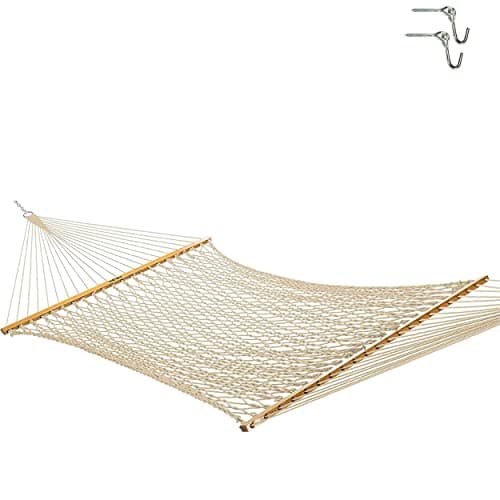
Yes, and it depends almost entirely on the fiber. Cotton stretches when it gets wet and does not fully come back — Pawleys Island lists exactly that among the trade-offs of its cotton rope. Synthetic ropes such as DURACORD and DuraCord are sold on resisting it. Nylon camping hammocks creep under load each night and largely recover when unloaded.
Part of our guides hub. This question usually arrives as a complaint — the hammock sits lower than it did, or touches the ground now, or the lay has gone soft. All three are the same phenomenon, and in most cases it is fixable with the suspension rather than with a new hammock.
Stretch by material
| Material | Stretches? | Recovers? | What the makers publish |
|---|---|---|---|
| Cotton rope | Yes, especially when wet | Not fully | Pawleys Island lists cotton as absorbing water, stretching when wet and able to mildew if left out |
| Synthetic rope (DURACORD, DuraCord) | Much less | Yes | Pawleys describes DURACORD as built to withstand sun and rain; Hatteras publishes DuraCord as the densest rope on the hammock market at 85 ft per lb |
| Polyester fabric | Minimal | Yes | Published weatherproofing research describes polyester as resisting moisture, drying quickly and not prone to mold or fading |
| Nylon (camping hammocks) | Yes, under load | Largely, once unloaded | Makers publish fabric weights (70D on the ENO DoubleNest) rather than stretch figures |
| Cotton macrame or Brazilian weave | Yes | Not fully | Artisan makers rarely publish material behavior at all |
Quick picks
Tap any row to jump to the full write-up. Prices come straight from Amazon and are refreshed daily; where a figure is missing the link takes you to the live one.
| # | Product | Best for | Headline spec | Price |
|---|---|---|---|---|
| 1 | Pawleys Island DURACORD Rope HammockThe rope hammock built for weather — DURACORD is marketed specifically to withstand sun and rain where cotton cannot. | Rope you can leave outside | 450 lb capacity | |
| 2 | 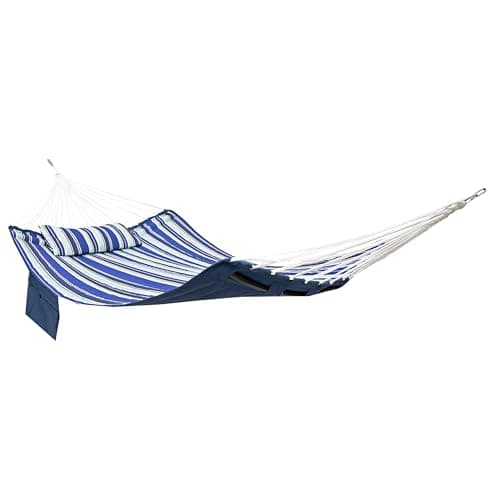 Sunnydaze Catalina Beach Quilted Double HammockDye-treated polyester that resists sun fading, which is the difference between a hammock that lasts a season and one that lasts several. | Quilted comfort that tolerates sun | 450 lb capacity | |
| 3 | 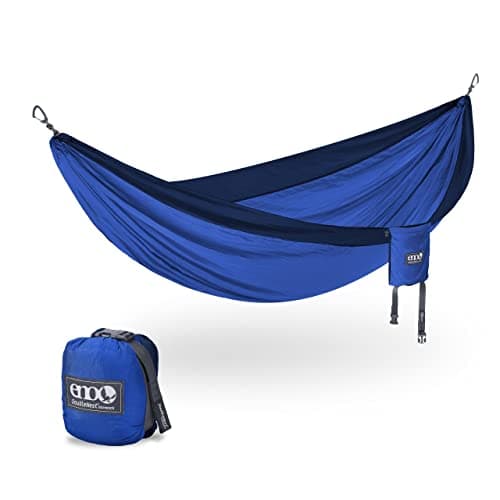 ENO DoubleNest HammockThe most widely sold camping hammock there is, and OutdoorGearLab's best all-around pick. | Best all-around camping hammock | 400 lb capacity | |
| 4 | No image DutchWare Adjustable Structural RidgelineAn adjustable UCR ridgeline from 26 to 135 in — set your sag once and the hammock hangs the same way forever. | Repeatable sag, every time | Adjustable UCR ridgeline, 26 in minimum to 135 in maximum |
#ad — the buy links above are affiliate links. See our affiliate disclosure.
Why cotton is the outlier
Cotton is hygroscopic: it takes up water, the fibers swell and lengthen, and when they dry they do not entirely return to where they started. Repeat that across a season of dew and rain and a cotton rope hammock noticeably lengthens. That is not a defect, it is what the fiber does, and it is the same property that makes cotton the softest and most breathable surface in this category. The trade is stated honestly on rope hammocks and in the leave-outside guidance on can you leave a hammock outside.
The practical consequence: a cotton hammock that lives outdoors will stretch faster than one that comes in. If you want the open rope weave without the creep, the same hammocks exist in synthetic rope — the Pawleys Island DURACORD is the Original Deluxe's weatherproof twin at the same 450 lb and 13 ft by 55 in, and the Sunnydaze Catalina Beach is a dye-treated, quick-dry polyester quilted double at 450 lb with a 74 by 55 in bed.
Getting the hang back
- Shorten the suspension, not the hammock. This is what the attachment loops on webbing straps are for. Move up one or two loops and the seat height comes back. Nothing else needs to change.
- Raise the anchors. On a tree hang, go higher up the trunk. A stretched hammock needs more anchor height at the same span to hold the same seat height.
- Fit a structural ridgeline. This is the permanent fix for a gathered-end hammock, because the ridgeline — not the fabric — then defines the sag. DutchWare publishes a rule of thumb of about 83% of the hammock's length and an adjustable line covering 26 to 135 in.
- Shorten the chains. On a spreader-bar hammock, the extension chains are adjustable by design. Take a link or two out and the bed comes back up.
- Dry it, then re-check. A wet cotton hammock is at its longest. Let it dry fully before deciding how much has actually changed.
When it is not stretch
- The knots have crept. Whoopie slings and cinch buckles settle in over the first few nights. Re-set them before blaming the fabric.
- The anchors have moved. Trees sway, posts settle, and a stand on soft ground sinks. Measure the span again.
- The hammock was always that long. Listed dimensions are bed length only; chains, carabiners and spreader bars add length that nobody includes in the mental arithmetic.
- It is wear, not stretch. Fraying, thinning or discolored rope is a safety matter rather than an adjustment — see how long does a hammock last and are hammocks safe.
Common questions
Do hammocks stretch out over time?
Cotton does, particularly when it gets wet, and it does not fully recover. Synthetic ropes such as DURACORD and DuraCord are sold specifically on resisting it, and polyester fabric is described in published research as resisting moisture and drying quickly.
How do you fix a hammock that has stretched?
Shorten the suspension rather than the hammock. Move up one or two attachment loops on the straps, raise the anchors, or take a link out of the extension chains on a spreader-bar hammock.
Does a nylon camping hammock stretch?
It creeps under load each night and largely recovers once you get out. Makers publish fabric weights — 70D on the ENO DoubleNest — rather than stretch figures, so treat recovery as normal behavior rather than a fault.
Will a ridgeline stop a hammock stretching?
It stops stretch from changing your lay, which is the part that bothers people. With a structural ridgeline fitted, the ridgeline defines the sag instead of the fabric. DutchWare publishes a rule of thumb of about 83% of hammock length.
Does leaving a hammock outside make it stretch faster?
For cotton, yes — repeated wetting and drying is the mechanism. Published guidance is that cotton should be avoided for year-round outdoor use and that even weather-resistant hammocks should come in for heavy snow or an extended wet season.
Sources
Every specification on this page traces to one of these — manufacturer data, owner's manuals, published standards and named independent publications, all linked so you can check them yourself.
Read next
Spotted something we got wrong? Tell us — corrections are part of our editorial policy.