How to Keep a Hammock Stand From Tipping
A loaded stand almost never tips. An empty one in a gust, or a stand carrying a rotating chair, is a different story — and the fixes are not the same.
By Mike M. · Last updated
Knot & Nap is reader-supported. We earn from qualifying purchases as an Amazon Associate, at no extra cost to you. Commissions never decide what gets recommended — here is how we pick.
Most tipping comes from three causes: a base narrower than the load path, an empty hammock acting as a sail in wind, and a rotating hanging chair walking its stand across a hard surface. Fix them with a wider base and a heavier frame, by taking the hammock off in high wind, and by putting grip under the feet.
Part of our guides hub. A hammock stand is a surprisingly well-behaved object when it is doing its job: a person lying in the middle of a frame pulls both ends inward and downward, which is the direction the frame is designed for. Trouble comes from loads it was not designed for, and those are predictable enough to plan around before you buy.
The three ways a stand actually moves
- Sideways tipping. Someone sits on the edge of the bed, or two people load one side. The load line moves outside the base and the frame rolls. Base width is the defence.
- Wind. An empty hammock is a sheet of fabric slung between two uprights, and in a gust it catches like a sail. This is far and away the most common way a stand ends up on its side, and it almost always happens with nobody in it.
- Walking and sliding. Not strictly tipping, but it ends the same way. Bare steel feet on a patio or deck creep in the direction of the swing, and a rotating hanging chair is the worst case because the force never stops changing direction.
What to look for in a stand that stays put
- A published footprint. You cannot judge stability from a photograph. The Tranquillo adjustable frame publishes 28.3 in of width at its minimum setting and 32.8 in at its maximum; most listings publish nothing, which tells you something in itself.
- Frame weight. Mass resists wind and resists walking. A heavier frame is genuinely more stable, which is the one way a steel garden stand beats a folding aluminum one.
- Base geometry, not just base size. The GREENSTELL chair stand uses an X-shaped base rather than two rails specifically for more ground contact, which is the right answer under a chair that rotates.
- Feet you can trust on your surface. Rubber feet on hard ground, broad feet on soft ground. The ENO SoloPod is the only stand in our research that publishes rubber feet as a specification.
- Height adjustment, used conservatively. The Sunnydaze adjustable chair stand reaches 93 in, and a taller setting raises the tipping moment. Use the lowest setting that hangs the chair correctly.
Quick picks
Tap any row to jump to the full write-up. Prices come straight from Amazon and are refreshed daily; where a figure is missing the link takes you to the live one.
| # | Product | Best for | Headline spec | Price |
|---|---|---|---|---|
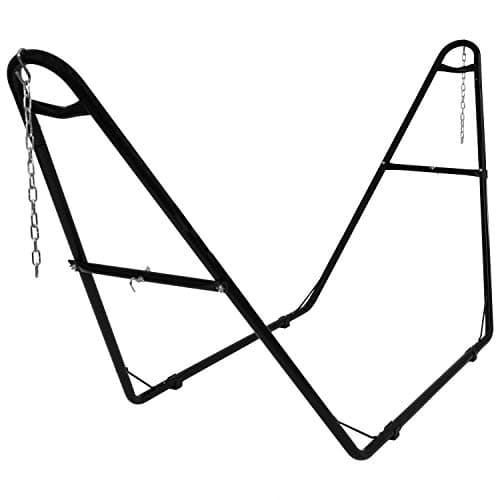
| 1 | Sunnydaze Universal Hammock StandUniversal fit, powder-coated steel and a 550 lb rating — the stand most people should buy when the hammock came without one. | Best overall stand | Universal compatibility | |
| 2 | 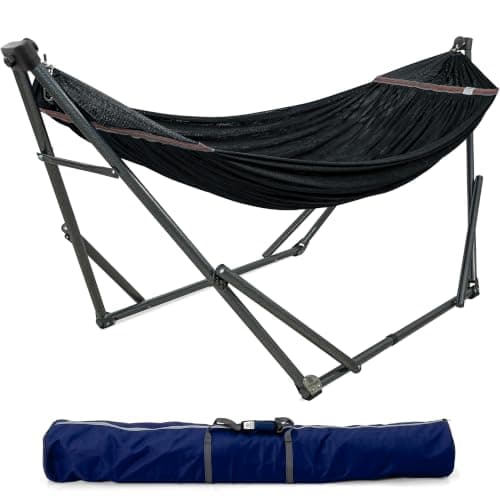 Tranquillo 600 lb 2-Person Adjustable Hammock Stand600 lb, adjustable and collapsible — the rare stand that does not trade capacity for portability. | Heavy-duty and still portable | 600 lb capacity | |
| 3 | No image GREENSTELL Hammock Swing C-StandAn X-shaped base instead of two rails — more ground contact, which is what stops a spinning chair walking the stand across the patio. | Stability on hard floors | 330 lb maximum load |
#ad — the buy links above are affiliate links. See our affiliate disclosure.
1. Best overall stand
Sunnydaze Universal Hammock Stand
Universal fit, powder-coated steel and a 550 lb rating — the stand most people should buy when the hammock came without one.
Specifications
- Universal compatibility
- Powder-coated steel
- 550 lb capacity
- Lightweight for its class
Source: Bob Vila 2026. We publish specs we can attribute and leave the rest blank rather than assuming a typical value.
What it does well
- Named best overall hammock stand by Bob Vila in 2026
- 550 lb clears nearly any hammock you would hang on it
- Universal fit means the hammock, not the stand, decides your options
Where it falls short
- Powder-coated steel still wants a dry winter home
- Span is adjustable but not published as a figure
Product photograph supplied by Amazon.
#ad we may earn a commission · price as of October 17, 2026
2. Heavy-duty and still portable
Tranquillo 600 lb 2-Person Adjustable Hammock Stand
600 lb, adjustable and collapsible — the rare stand that does not trade capacity for portability.
Specifications
- 600 lb capacity
- Adjustable
- Collapsible
- Portable
Source: Walmart product listing, surfaced 2026-09-22. We publish specs we can attribute and leave the rest blank rather than assuming a typical value.
What it does well
- 600 lb with a collapsible frame is an unusual combination
- Adjustable length covers several hammock sizes
Where it falls short
- Heavier than a true backpacking stand
- Packed weight is not published
Product photograph supplied by Amazon.
#ad we may earn a commission · price as of October 17, 2026
3. Stability on hard floors
GREENSTELL Hammock Swing C-Stand
An X-shaped base instead of two rails — more ground contact, which is what stops a spinning chair walking the stand across the patio.
Specifications
- 330 lb maximum load
- X-shaped base for increased ground contact
- Spring hook included
- Indoor or outdoor use
Source: GREENSTELL Amazon listing, 2026. We publish specs we can attribute and leave the rest blank rather than assuming a typical value.
What it does well
- The X base is steadier than a two-rail frame under a rotating chair
- A spring hook is included, which softens the bounce
Where it falls short
- The cross base takes floor space in all four directions
- 330 lb still trails the chairs quoted at 500 lb
No licensed photograph of this product is available to us yet.
The wind rule
If there is a single habit worth adopting, it is this: unhook the hammock when you are not using it and a blow is forecast. The frame alone presents almost no sail area; the hammock presents a great deal. It is also the cheapest possible fix, and it solves the other half of the problem at the same time, because ultraviolet and rain are what age a hammock fastest — the reasoning is in can you leave a hammock outside and the routine is in how to store a hammock.
On soft ground you have a second option: stakes or ground anchors through the feet, which turn a free-standing frame into a pinned one. On a patio or a deck that option does not exist, which is the central constraint of the best hammock stands for a patio. There, stability has to come from mass, base width and grip.
Hard surfaces: grip beats everything
On pavers, concrete or composite decking, the failure mode is creep rather than a sudden tip. Each swing nudges the frame a fraction of an inch in one direction and nothing nudges it back. Rubber mats, paver pads or furniture feet under every contact point stop it, level a sloped slab at the same time, and incidentally save the surface from the gray scuff arcs that bare steel leaves. Keep the frame near a wall rather than out in the open where it can catch wind from any direction.
Hanging chairs need their own answer
A chair stand carries its whole load on one side of the frame, so it is working against a tipping moment all the time rather than only when someone leans. Three things help: an X or cross base rather than two rails, the lowest height setting that still clears the floor, and keeping the published capacity well clear of your actual load — chair stands publish 300 lb to 400 lb while the chairs on them often publish 500 lb, which we work through in how much weight can a hammock chair hold. A spring hook, as GREENSTELL includes, also damps the bounce that sets a stand rocking.
What not to do
- Do not weigh the base down with loose bricks or sandbags on one side. Uneven ballast shifts the tipping line rather than widening the base.
- Do not set it up on a slope and hope. A sloped surface loads one pair of feet harder, and that pair is the one that slides. Shim it level.
- Do not sit on the edge of the bed to put your shoes on. Edge loading is the mechanism behind nearly every sideways tip.
- Do not assume a high published capacity means a stable stand. Capacity is about the frame not bending. Stability is about base geometry and weight, and the two are published separately when they are published at all.
Common questions
How do you stop a hammock stand from tipping over?
Choose a frame with a wide, published base and real weight, keep it level and shimmed on sloped ground, put grip under the feet on hard surfaces, use ground anchors on soft ground, and take the hammock off the stand when high wind is forecast. Avoid sitting or standing on the edge of the bed.
Can a hammock stand blow over in the wind?
Yes, and it is the most common way one ends up on its side. The frame alone catches very little wind; an empty hammock slung between the uprights catches a lot. Unhooking the hammock when you are not using it removes the sail and protects the fabric at the same time.
Do hammock stands need ground anchors?
Not for normal use, but they are the most effective wind defence available on grass or soil. On a patio, deck or concrete slab you cannot stake anything down, so stability has to come from base width, frame weight and grip under the feet instead.
Why does my hammock stand slide across the patio?
Bare steel feet creep a fraction of an inch with each swing and nothing pushes them back. Rubber mats, paver pads or furniture feet under each contact point stop the creep, level a sloped slab and prevent the scuff marks steel leaves on pavers and composite decking.
Are chair stands less stable than hammock stands?
They carry the load on one side of the frame, so they work against a tipping moment constantly rather than only under uneven loading. Look for an X or cross base rather than two rails, use the lowest height setting that clears the floor, and leave margin between your load and the published 300 lb to 400 lb capacity.
Sources
Every specification on this page traces to one of these — manufacturer data, owner's manuals, published standards and named independent publications, all linked so you can check them yourself.
Read next
Spotted something we got wrong? Tell us — corrections are part of our editorial policy.