Haven Tent Review
Spreader bars at both ends, an insulated air mattress inside, and a bed that genuinely lies flat. It is the heaviest way to sleep in a hammock and the only one that sleeps like a cot.
By Mike M. · Last updated
Knot & Nap is reader-supported. We earn from qualifying purchases as an Amazon Associate, at no extra cost to you. Commissions never decide what gets recommended — here is how we pick.
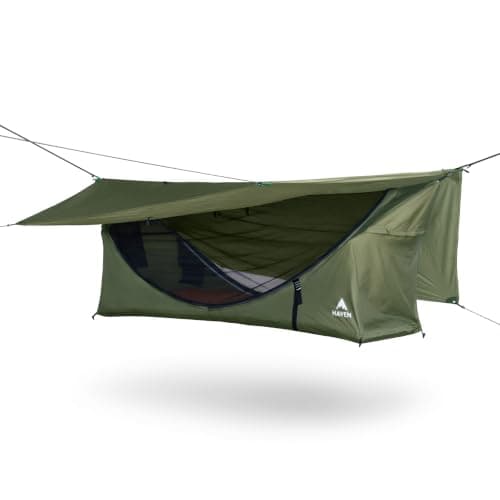
Haven makes the flat-lay hammock tent most people mean when they say the words. Three models share a 210T polyester body, 4,000 mm waterproofing and an insulated air mattress held flat by spreader bars: the Original at 24 by 78 in, the XL at 30 by 80 in, and the canvas Safari at 350 lb. Buy the XL if you are over roughly 160 lb.
Part of our camping hammocks hub. We have not slept in a Haven ourselves — see how we pick — so every figure here is published by Haven on its own product pages or is a fact about the live retail listing, and each is labeled as such. Haven sells direct and on Amazon, and all four rows below resolved to live, in-stock listings, so the prices and product photos on this page are the real current ones.
Quick picks
Tap any row to jump to the full write-up. Prices come straight from Amazon and are refreshed daily; where a figure is missing the link takes you to the live one.
| # | Product | Best for | Headline spec | Price |
|---|---|---|---|---|
| 1 | Haven Tent Original Lay-Flat Hammock TentA hammock tent built around a genuinely flat lay, for people who cannot sleep in a curve. | Sleeping flat off the ground | 24 x 78 in (60 x 198 cm) sleeping platform | |
| 2 | 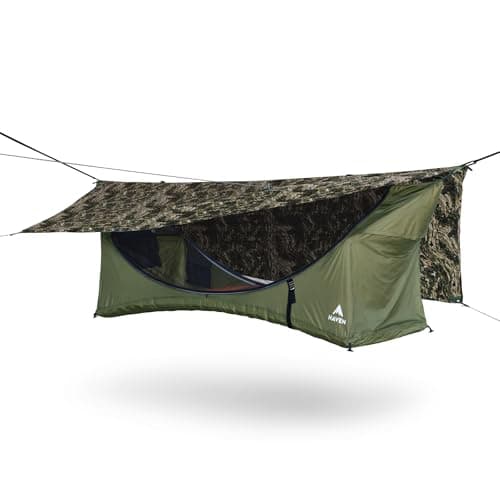 Haven Tent XL Lay-Flat Hammock TentThe wider, longer Haven: six inches more platform width and the version Haven itself points larger campers toward. | Taller and heavier campers | 30 x 80 in (76 x 203 cm) sleeping platform | |
| 3 | 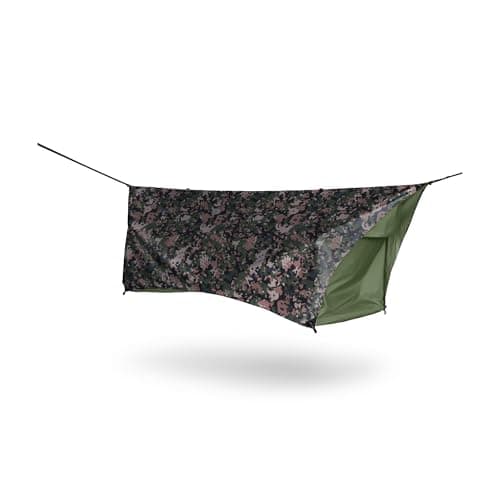 Haven Safari Lay-Flat Hammock TentThe canvas Safari trades every ounce of packability for 350 lb of rating and a shelter you leave standing for a week. | Basecamp and overlanding | 350 lb / 158 kg published weight rating | |
| 4 | 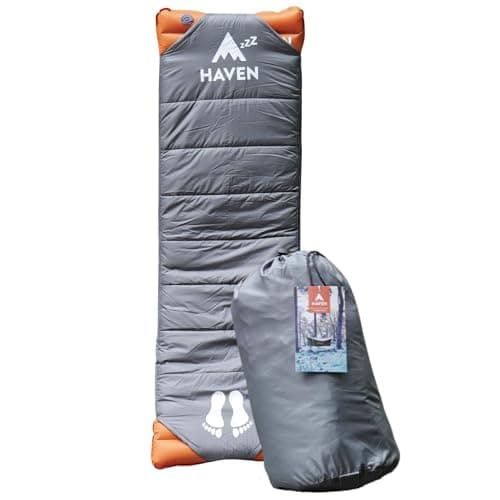 Haven Insulated Pad CoverThe accessory that answers the one complaint every hammock camper eventually makes about an air pad in the cold. | Cold-weather Haven setups | Insulated cover that wraps a Haven sleeping pad |
#ad — the buy links above are affiliate links. See our affiliate disclosure.
1. Sleeping flat off the ground
Haven Tent Original Lay-Flat Hammock Tent
A hammock tent built around a genuinely flat lay, for people who cannot sleep in a curve.
Specifications
- 24 x 78 in (60 x 198 cm) sleeping platform
- 285 lb / 129 kg published weight rating
- 104 in minimum distance between end loops
- 210T polyester body, 4,000 mm waterproofing
- Hammock alone: 2 lb 15 oz trail weight
- With standard fly and Premium pad: 5 lb 13.2 oz trail weight
- Packed size with pad and fly 15 x 6 x 6 in
- Premium insulated pad R5, 2 lb 1 oz, 30d brushed polyester
Source: haventents.com Haven Tent product page, read 2026-11-04. We publish specs we can attribute and leave the rest blank rather than assuming a typical value.
What it does well
- Flat lay solves the single biggest complaint about hammock sleeping
- Enclosed, so netting and weather cover are part of the design
- Haven publishes a trail weight for every fly and pad combination, not one headline figure
Where it falls short
- Heavier than a plain hammock plus net
- Haven points campers over roughly 160 lb at the wider XL instead
- 104 in between end loops is a longer span than a gathered-end hammock needs
Product photograph supplied by Amazon.
#ad we may earn a commission · price as of November 4, 2026
2. Taller and heavier campers
Haven Tent XL Lay-Flat Hammock Tent
The wider, longer Haven: six inches more platform width and the version Haven itself points larger campers toward.
Specifications
- 30 x 80 in (76 x 203 cm) sleeping platform
- 285 lb / 129 kg published weight rating
- 108 in minimum distance between end loops
- 210T polyester body, 4,000 mm waterproofing
- Hammock alone: 3 lb 2 oz trail weight
- With standard fly and True Level pad: 6 lb 9.3 oz trail weight
- Packed size 16 x 8 x 6 in
- True Level Insulated pad R5.3; True Level Spectre pad R2.5
Source: haventents.com Haven XL product page, read 2026-11-04. We publish specs we can attribute and leave the rest blank rather than assuming a typical value.
What it does well
- Haven publishes a platform size, a weight rating, a minimum span and a per-configuration weight for every kit
- Spreader bars hold the bed genuinely flat, so side and stomach sleepers get a usable surface
- Full kit arrives with bug net, fly, straps, stakes, guy lines, carabiners, gear sling and an insulated air mattress
Where it falls short
- 108 in between end loops is a longer span than a plain gathered-end hammock needs
- Heaviest trail weight here once the fly and insulated pad are on
- One person per tent, so a couple buys two
Product photograph supplied by Amazon.
#ad we may earn a commission · price as of November 4, 2026
3. Basecamp and overlanding
Haven Safari Lay-Flat Hammock Tent
The canvas Safari trades every ounce of packability for 350 lb of rating and a shelter you leave standing for a week.
Specifications
- 350 lb / 158 kg published weight rating
- 300d polyester body, 4,000 mm waterproofing
- 116 in minimum distance between end loops
- Safari rainfly 2 lb 2 oz, 300d polyester canvas, 118 x 81 in
- 11 lb 11 oz packaged with the Safari fly and True Level Safari pad
- Packed size 20 x 10 x 5 in
- Pads: Basic Safari Insulated R3, True Level Safari Insulated R5.3
Source: haventents.com Haven Safari product page, read 2026-11-04. We publish specs we can attribute and leave the rest blank rather than assuming a typical value.
What it does well
- 350 lb is the highest rating Haven publishes, 65 lb more than the Original or the XL
- 300d canvas is a different durability class from a 210T hammock body
- The R5.3 pad option is real cold-weather insulation rather than a summer mat
Where it falls short
- Nearly 12 lb packaged, which rules it out of any backpacking use
- 116 in minimum span is the longest here and limits where it can hang
- The most expensive Haven in the line
Product photograph supplied by Amazon.
#ad we may earn a commission · price as of November 4, 2026
4. Cold-weather Haven setups
Haven Insulated Pad Cover
The accessory that answers the one complaint every hammock camper eventually makes about an air pad in the cold.
Specifications
- Insulated cover that wraps a Haven sleeping pad
- Haven states the insulation is varied across the cover to place it where it is needed most
- Sold separately from the tent kits
Source: haventents.com Haven XL kit options and the Haven Insulated Pad Cover listing, read 2026-11-04. We publish specs we can attribute and leave the rest blank rather than assuming a typical value.
What it does well
- Targets cold spots rather than adding uniform bulk
- Cheaper than replacing a pad with a higher R-value one
Where it falls short
- Haven publishes no R-value and no weight for the cover itself
- Another separate purchase on a tent that is already expensive
- Only useful if you already own a Haven pad
Product photograph supplied by Amazon.
#ad we may earn a commission · price as of November 4, 2026
What a Haven actually is
Every other hammock on this site hangs from two gathered ends, which means the fabric wraps you and the bed curves. That curve is the whole argument of hammock vs tent: it is wonderful for back sleepers and a problem for everyone else. Haven's answer is to put an aluminum spreader bar at each end, drop a shaped insulated air mattress inside, and turn the hammock into a suspended platform.
The consequences run through the whole product. The bed is flat, so side and stomach sleeping work. The pad is part of the design rather than a thing you fight to keep underneath you, which is why Haven ships one in the kit. The bug net is built in and the rainfly is in the box, so the thing is a complete shelter out of one bag. And it weighs what a one-person tent weighs, because structurally it almost is one.
It is also strictly a one-person shelter. Haven states one person per Haven and tells couples to hang two side by side, which is a real constraint on a trip where two people were expecting to share. If that is you, best hammock tents covers the alternatives.
The published numbers, side by side
| Haven Tent (Original) | Haven XL | Haven Safari | |
|---|---|---|---|
| Sleeping platform | 24 x 78 in (60 x 198 cm) | 30 x 80 in (76 x 203 cm) | Pads are 30 x 80 in |
| Weight rating | 285 lb / 129 kg | 285 lb / 129 kg | 350 lb / 158 kg |
| Minimum span between end loops | 104 in | 108 in | 116 in |
| Body fabric | 210T polyester, 4,000 mm | 210T polyester, 4,000 mm | 300d polyester, 4,000 mm |
| Hammock alone, trail weight | 2 lb 15 oz | 3 lb 2 oz | 5 lb 13 oz packaged |
| Full kit, with fly and insulated pad | 5 lb 13.2 oz trail / 6 lb 12 oz packaged | 6 lb 9.3 oz trail / 7 lb 10.2 oz packaged | 11 lb 11 oz packaged |
| Packed size with pad and fly | 15 x 6 x 6 in | 16 x 8 x 6 in | 20 x 10 x 5 in |
| Pad insulation | Premium R5 | True Level R5.3 or Spectre R2.5 | R3 or R5.3 |
Two things stand out in that table. The first is that Haven publishes a trail weight for every combination of fly and pad rather than one flattering figure, which is the behavior we keep asking for from cottage brands and rarely get — compare the gaps we had to note in our Hammock Gear review. The second is the minimum span row, and it is the one most buyers will not have thought about.
The span is the catch nobody mentions
Spreader bars make the bed flat and they also make it rigid, and a rigid bed cannot be hung between two trees twelve feet apart. Haven publishes a minimum distance between end loops of 104 in for the Original, 108 in for the XL and 116 in for the Safari — that is roughly 8 ft 8 in, 9 ft and 9 ft 8 in before suspension and sag are accounted for. A gathered-end camping hammock will hang happily inside that.
In practice this means Haven sites are a subset of hammock sites. Two slim trees close together, a tight stand of saplings, the narrow gap between a post and a wall: all of those work for a DoubleNest and none of them work for a Safari. Read hammock hanging distance and angle before you commit, and do not assume a stand solves it either — most backyard frames are built around a 9 or 10 ft gathered-end hammock, not a 116 in rigid platform.
Haven Tent (Original): the one to buy under 160 lb
The Original is the lightest and smallest Haven: a 24 by 78 in platform, 285 lb rating, 2 lb 15 oz for the hammock alone and 5 lb 13.2 oz of trail weight with the standard fly and the Premium R5 pad. The full kit arrives with the hammock body, built-in bug net, two aluminum spreader bars, the rainfly, two 6 ft tree straps, four guy lines, four stakes, two carabiners, a gear sling and an air mattress with a pump bag. Nothing else is needed to sleep in it the day it arrives, which is rare in hammock camping and the reason our do hammocks come with straps guide exists.
Honest cons: a 24 in platform is narrower than it sounds once a pad is in it, and Haven itself points campers above roughly 160 lb at the XL rather than this one, which is an unusually candid thing for a brand to publish and worth believing. The 104 in minimum span rules out tight tree pairs. And at nearly 6 lb packed it is heavier than a gathered-end hammock, net and tarp doing the same job — see best backpacking hammocks if weight is the deciding factor.
Haven XL: the default recommendation
The XL adds six inches of platform width and two inches of length for about three ounces of hammock weight, which is the best trade in the range. It is the model Haven directs larger frames and taller campers to, and the extra width is what makes side sleeping comfortable rather than merely possible. The True Level Insulated pad is R5.3; the lighter Spectre pad is R2.5 and the right choice only in summer.
Honest cons: the weight rating does not go up with the size. The XL is still 285 lb, exactly like the Original, so the wider platform buys comfort rather than capacity — if a published capacity is your constraint, the Safari is the only answer in the line. The 108 in span requirement is longer. And with the standard fly and the True Level pad you are carrying 6 lb 9.3 oz on the trail, which is tent territory. Big and tall campers should also read best camping hammocks for big guys, where several gathered-end hammocks publish much higher ratings.
Haven Safari: a basecamp shelter, not a hammock
The Safari swaps the 210T body for 300d polyester, keeps the 4,000 mm waterproofing, and publishes 350 lb — 65 lb more than either lighter model. Its rainfly is 300d polyester canvas at 118 by 81 in and 2 lb 2 oz, and the whole thing lands at 11 lb 11 oz packaged with the Safari fly and the True Level Safari pad, packing to 20 by 10 by 5 in.
That weight is the point rather than a flaw. This is the version for a vehicle, an overlanding setup or a camp you pitch once and live in for a week, where 300d fabric and a canvas fly matter more than ounces. Its pad options are R3 and R5.3, so it can be set up as a genuinely cold shelter.
Honest cons: nearly 12 lb rules out every form of walking in, the 116 in minimum span is the most restrictive in the line, and it is the most expensive Haven. It is also still one person. If you want a high published capacity in something you can carry, a gathered-end hammock will beat it on both counts — our heavy duty hammocks page lists the ratings.
The accessory that matters: the insulated pad cover
An air mattress is a poor insulator at the shoulders and hips, and in a suspended bed with moving air underneath that shows up as the cold spots hammock campers call cold butt syndrome. Haven's answer is a pad cover with the insulation varied across it to place loft where the pressure is. Haven does not publish an R-value or a weight for the cover itself, which we would like to see, so treat it as a comfort upgrade rather than a quantified one.
If you are comparing that approach against the standard hammock solution, read underquilt vs sleeping pad and do I need an underquilt?. An underquilt hangs outside the hammock and is the better answer for a gathered-end setup; inside a spreader-bar platform, a pad and a cover are the only option that works.
What Haven gets right, and what we would change
- Right: the specification page. Platform size, weight rating, minimum span, per-configuration trail and packaged weights, fabric, hydrostatic head, pad R-values and a full kit list, all published. Very few hammock brands publish half of that.
- Right: the kit is complete. Straps, stakes, guy lines, carabiners, bug net, fly, gear sling and an insulated mattress in one box. No second shopping trip.
- Right: the honesty about fit. A brand telling you to buy the cheaper model if you are under 160 lb is the opposite of upselling.
- Would change: the capacity. 285 lb across both the Original and the XL is the one number that has not moved with the size, and it is the figure most likely to exclude a buyer.
- Would change: the span disclosure. The minimum distance between end loops is the most consequential spec on the page and it sits well below the photographs.
- Would change: the cover's numbers. An insulated accessory sold against cold spots should publish an R-value.
Who should buy a Haven, and who should not
Buy one if you want to sleep in a hammock and cannot sleep in a curve. That is the whole case, and it is a strong one: side sleepers, stomach sleepers and people whose backs object to the banana shape get a flat suspended bed with the bug net and the weather cover already attached. Best hammocks for side sleepers and best camping hammocks for stomach sleepers cover the gathered-end attempts at the same problem, and none of them is as flat as this.
Do not buy one if you count grams, if you need a published capacity above 285 lb in a carryable shelter, if your usual sites are tight tree pairs, or if two of you were planning to share. In all four cases a gathered-end hammock with a bug net and a tarp is the better purchase, and hammocks with bug net and rainfly is where that shortlist lives.
Common questions
Is the Haven Tent worth it?
If a flat lay is what you want, yes — it is the product that actually delivers one, with the bug net, rainfly and insulated pad included so it sleeps the day it arrives. If you are weight-counting or need more than 285 lb of published capacity, a gathered-end hammock with a separate net and tarp does the job lighter and cheaper.
What is the weight limit on a Haven Tent?
Haven publishes 285 lb (129 kg) for both the Haven Tent and the Haven XL, and 350 lb (158 kg) for the canvas Safari. The rating does not increase between the Original and the XL: the XL buys platform width, not capacity.
Should I buy the Haven Tent or the Haven XL?
Haven's own guidance is the clearest answer: under roughly 160 lb the Original is the better fit because it is lighter and smaller, and above that the XL's 30 by 80 in platform is worth the extra three ounces. Taller campers should take the XL regardless, since it adds length as well as width.
How far apart do the trees need to be for a Haven Tent?
Further than for an ordinary hammock. Haven publishes a minimum distance between end loops of 104 in for the Original, 108 in for the XL and 116 in for the Safari, before suspension and sag. Spreader bars make the bed rigid, so a close tree pair that suits a gathered-end hammock will not take a Haven.
Can two people sleep in a Haven Tent?
No. Haven states one person per Haven and suggests couples hang two side by side. If a shared suspended shelter is the requirement, look at double camping hammocks or a tree tent instead.
Does the Haven Tent come with a sleeping pad?
The full kits do: Haven lists an insulated air mattress with a pump bag in the kit contents, alongside the hammock body, bug net, two spreader bars, rainfly, two 6 ft tree straps, four guy lines, four stakes, two carabiners and a gear sling. Haven also notes that the no-rainfly and no-pad kits ship without them, so check which configuration you are adding to the cart.
Can you use a Haven Tent on the ground?
Yes. Haven states it can be pitched on the ground in bivy mode using trekking poles or sticks, which is a useful fallback on a treeless site and one of the clearer signs that this product sits between a hammock and a tent.
Sources
Every specification on this page traces to one of these — manufacturer data, owner's manuals, published standards and named independent publications, all linked so you can check them yourself.
Read next
Spotted something we got wrong? Tell us — corrections are part of our editorial policy.